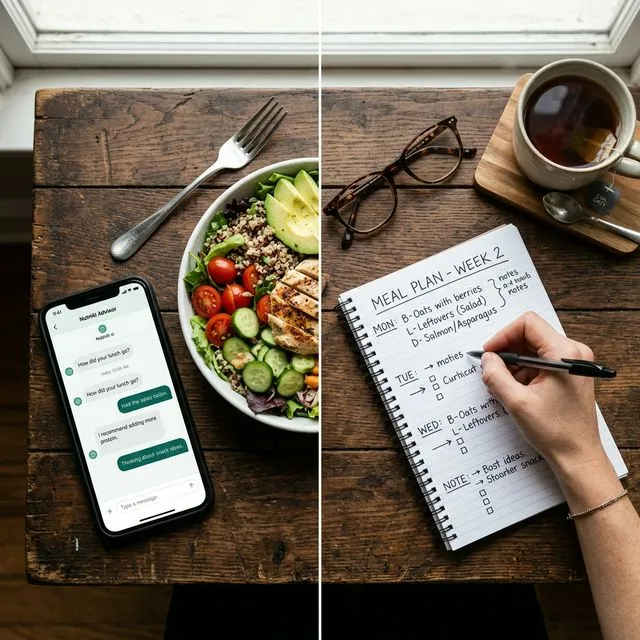
An AI nutritionist can analyze your meals in seconds, track macros from a photo, and give feedback 24/7 — all for under $15 a month. A human dietitian brings clinical expertise, emotional support, and the ability to manage complex medical conditions. So which one do you actually need?
The honest answer: it depends on your situation. For most people tracking their daily intake and working toward general fitness goals, AI is more than enough. For medical nutrition therapy, eating disorders, or conditions like diabetes or kidney disease, a human professional is irreplaceable. Here’s a detailed breakdown to help you decide.
The Cost Gap Is Massive
Let’s start with the elephant in the room. A registered dietitian in the US typically charges $150–$300 for an initial consultation and $75–$150 for follow-up sessions. Most people need at least one session per month to see results — that’s $900–$1,800 per year minimum.
AI nutrition tools, by contrast, range from free to about $10–$15 per month. Even premium plans with photo-based meal tracking, personalized recommendations, and daily feedback cost a fraction of a single dietitian session. This cost difference is the primary reason AI nutrition tools have exploded in adoption since 2023.
That said, many insurance plans cover registered dietitians for qualifying medical conditions (obesity, diabetes, GI disorders). If your insurance covers it, the cost gap narrows significantly.
What AI Does Better
1. Availability
AI doesn’t have office hours. You can log your midnight snack, ask about a restaurant menu at 7am, or check macros while traveling internationally — all instantly. A human dietitian typically responds within 4–12 hours during business days.
This 24/7 availability matters more than people think. A 2022 study in the Journal of Medical Internet Research found that users who received real-time feedback on their meals were 2.3× more likely to stay within their calorie targets compared to those who received feedback with delays.
2. Consistency and Speed
AI tools deliver the same quality of analysis whether it’s their first assessment or their ten-thousandth. They don’t experience fatigue, bad days, or cognitive overload. When you send a meal photo to an AI calorie counter, you get a macro breakdown in under 3 seconds — every single time.
3. Pattern Recognition at Scale
AI excels at spotting trends across weeks and months of food data — things like “you consistently under-eat protein on weekends” or “your fiber intake drops when you travel.” A human dietitian can notice patterns too, but only if you provide detailed logs. AI collects and analyzes this data automatically.
4. Frictionless Tracking
The biggest advantage of AI nutrition tools is reducing daily effort. Instead of manually searching food databases for every ingredient, you take a photo or describe your meal in a sentence. Our macro tracker from photo approach eliminates the step that causes most people to quit tracking — the tedious logging process.
What Humans Do Better
1. Clinical Judgment
AI models are trained on population-level data, which means they give good general advice. But nutrition becomes highly individual when medical conditions are involved. A registered dietitian can interpret lab results, coordinate with your doctor, adjust for medication interactions, and create therapeutic nutrition plans for conditions like:
- Type 1 and Type 2 diabetes
- Chronic kidney disease (where protein must be carefully controlled)
- Celiac disease and food allergies
- Eating disorders (anorexia, bulimia, binge eating)
- Post-bariatric surgery nutrition
For these situations, AI is not a replacement — it’s a supplement at best. The clinical nuance required is beyond what current AI models can safely provide.
2. Emotional Support and Accountability
Nutrition is deeply emotional. Stress eating, comfort food habits, body image issues, and cultural food relationships all affect what and how we eat. A human dietitian can listen, empathize, and adapt their approach based on what’s going on in your life.
AI can remind you to drink water and suggest protein-rich snacks. It cannot notice that you’ve been stress-eating every evening since a family crisis and adjust its entire strategy accordingly.
3. Behavioral Coaching
Long-term dietary change is fundamentally a behavior change problem. Dietitians trained in motivational interviewing and cognitive behavioral therapy (CBT) techniques can help you identify triggers, build better habits, and work through setbacks in a way that AI currently cannot replicate.
Side-by-Side Comparison
| Factor | AI Nutritionist | Human Dietitian |
|---|---|---|
| Cost | $0–$15/month | $75–$300/session |
| Availability | 24/7, instant | Business hours, 4–12h delay |
| Tracking effort | Photo or text — seconds | Manual food diary |
| Medical conditions | General guidance only | Clinical expertise |
| Emotional support | Limited | Deep, empathetic |
| Personalization | Data-driven patterns | Holistic, intuitive |
| Scalability | Unlimited users | Limited by time |
When to Choose AI
An AI nutrition tool is likely sufficient if you:
- Want to lose weight, build muscle, or improve your diet — without a diagnosed medical condition
- Need help with daily calorie and macro tracking but can’t justify $150+ per session
- Prefer instant feedback over scheduled appointments
- Have used a dietitian before and just need ongoing tracking support
- Want to understand your eating patterns over time (protein trends, weekend vs. weekday habits)
In our experience building Nouri, this covers roughly 80% of people who start tracking their nutrition. They don’t need clinical intervention — they need awareness, accountability, and low-friction logging. That’s exactly what AI nutrition coaching delivers.
When to Choose a Human Dietitian
See a registered dietitian (RD or RDN) if you:
- Have a diagnosed medical condition that requires dietary management
- Are recovering from or struggling with an eating disorder
- Need nutrition support during pregnancy or breastfeeding
- Have multiple food allergies or intolerances that require careful planning
- Are preparing for or recovering from surgery (especially bariatric surgery)
- Have tried self-guided nutrition tracking and it hasn’t worked
The Academy of Nutrition and Dietetics recommends working with an RDN for any condition that requires medical nutrition therapy (MNT). If your doctor recommends a dietitian, that’s a strong signal that AI alone won’t be enough.
The Best Approach: Use Both
Here’s what most nutrition experts are starting to agree on: AI and human dietitians are not competitors — they’re complementary. The most effective approach for many people is:
- Use AI daily for meal tracking, macro monitoring, and immediate feedback. Tools like our calorie tracker without manual logging make this effortless.
- See a dietitian periodically (quarterly or as needed) for strategy adjustments, lab result reviews, and addressing behavioral patterns that AI can’t resolve.
This hybrid model gives you the consistency and convenience of AI with the depth and clinical expertise of a human professional — at a fraction of the cost of weekly dietitian appointments.
The Bottom Line
AI nutritionists aren’t replacing dietitians. They’re filling the gap between “doing nothing” and “seeing a professional” — a gap that applies to the vast majority of people who want to eat better but won’t spend $1,000+ a year on consultations.
For everyday nutrition tracking and general health goals, AI is faster, cheaper, and more accessible than any human professional. For medical conditions, eating disorders, and complex clinical needs, a registered dietitian remains essential. The smartest move is using both — AI for daily support, humans for periodic expert guidance.
Try AI nutrition tracking
Send a meal photo, get instant calorie and macro estimates, plus personalized guidance — all from Telegram.
Try Nouri Free
Sources
- Shan Z, et al. — “Digital health technology for dietary assessment in clinical and research settings.” Journal of Medical Internet Research, 2022.
- Academy of Nutrition and Dietetics — What is a Registered Dietitian Nutritionist?
- Coughlin SS, et al. — “Use of consumer wearable devices and AI in nutrition.” Applied Clinical Informatics, 2023.
- NIH — Artificial Intelligence in Personalized Nutrition
- British Dietetic Association — What is a Dietitian?

This article is for informational purposes only and does not constitute medical or dietary advice. Consult a qualified healthcare professional before making changes to your diet.