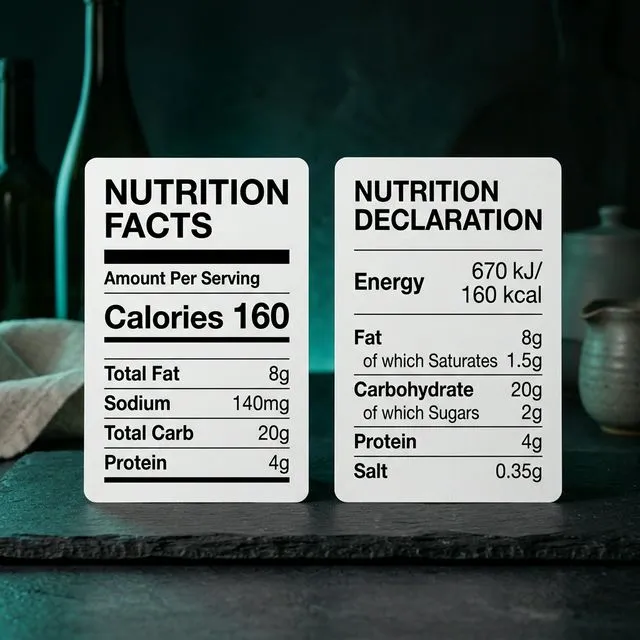
Calories and kilocalories are the same thing in everyday nutrition. When a food label says “160 Calories,” it means 160 kilocalories (kcal). The confusion exists because scientists use a different, much smaller unit also called a “calorie” — but you’ll almost never encounter it outside a chemistry textbook.
In short: 1 Calorie (with a capital C on US labels) = 1 kilocalorie (kcal) = 1,000 small calories (cal). Food labels, fitness apps, and diet plans all use the “big” version — they’re the same unit. Only kilojoules (kJ) need a conversion: 1 kcal ≈ 4.184 kJ.
If you’ve ever wondered why US labels say “Calories” while European ones say “kcal” — or whether your fitness app is showing the “right” number — this guide clears it up in simple terms. No chemistry degree needed.
The Short Answer: Cal = kcal on Food Labels
In the world of food and nutrition, these terms are interchangeable:
- Calorie (capital C) = kilocalorie (kcal) = 1,000 small calories
- A “small calorie” (lowercase c, abbreviated cal) is a unit from physics — the energy needed to heat 1 gram of water by 1°C
- A “kilocalorie” is 1,000 of those small calories — the energy to heat 1 kilogram of water by 1°C
So when your banana says “105 Calories,” it technically means 105 kilocalories, or 105,000 small calories. But nobody writes it that way because the numbers would be absurdly large.
The International System of Units (SI) actually prefers kilojoules (kJ) as the standard energy unit. 1 kcal ≈ 4.184 kJ. You’ll see kJ on labels in Australia, New Zealand, and some European countries.
Why Do Labels Use Different Terms?
The confusion is mostly a geography problem:
United States
US food labels regulated by the FDA use “Calories” (capital C). This is the standard Americans see on every Nutrition Facts panel. It always means kilocalories.
European Union
EU labels use “kcal” and often include “kJ” (kilojoules) as well, following EU Regulation No 1169/2011. This is technically more precise, since “kcal” leaves no room for ambiguity.
Other Countries
Australia uses kJ primarily, with kcal sometimes listed alongside. Many Asian and South American countries follow either the US or EU convention. The bottom line: regardless of the label format, the energy value is the same.
Quick Conversion Table
| Unit | Equals | Used where |
|---|---|---|
| 1 Calorie (Cal) | 1 kcal = 4.184 kJ | USA, Canada |
| 1 kilocalorie (kcal) | 1 Cal = 4.184 kJ | EU, most of the world |
| 1 kilojoule (kJ) | 0.239 kcal | Australia, NZ, SI standard |
| 1 small calorie (cal) | 0.001 kcal = 4.184 J | Lab/scientific use only |
The conversion that matters most: to go from kcal to kJ, multiply by 4.184. So a 2,000 kcal diet equals roughly 8,368 kJ.
Why Does This Confusion Matter?
For most people, it doesn’t — as long as you’re consistent. If your TDEE calculator says you need 2,200, and your food label says 350, you’re comparing the same units whether they’re called “Calories” or “kcal.”
But it can cause real problems in a few scenarios:
- Fitness app confusion — some apps display “cal” when they mean “kcal.” If your run shows “350 cal burned,” it means 350 kcal (not 0.35 kcal).
- Scientific literature — research papers use the precise “kcal” or “kJ.” Misreading a study that says “a 500 cal deficit” as 500 small calories would be a 1,000x error.
- International products — if you pick up a European snack bar showing “250 kJ,” that’s only about 60 kcal — not 250 calories.
The safest rule: when in doubt, check the unit on the label. “Cal” or “Calories” or “kcal” all mean the same energy unit. Only “kJ” requires a conversion.
What About Kilojoules (kJ)?
The kilojoule is the official metric unit of energy under the International System of Units. While most of the world still uses calories/kcal informally, some countries (particularly Australia and New Zealand) have adopted kJ as the primary label unit.
Quick mental shortcut: divide kJ by 4 to get an approximate kcal number. A 1,600 kJ meal is roughly 400 kcal. This isn’t exact (the real factor is 4.184), but it’s close enough for everyday use. Need a precise conversion? Use our kJ to kcal converter.
How Modern Tools Handle This Automatically
The reality is that most people don’t need to worry about unit conversions. Modern AI calorie counters handle the math automatically — you snap a photo of your food, and the tool returns a number in whichever unit your app is set to.
For packaged foods specifically, an AI food label scanner reads the nutrition panel in any language or unit system and reports the values in the format your app uses. No more squinting at a Japanese snack label trying to figure out if “100 cal” means 100 Calories or something else (it does — they’re the same).
This is one reason why tracking without manual logging has become popular. AI reads the label and normalizes everything for you.
The Bottom Line
Calories and kilocalories mean the same thing in nutrition. The “cal vs kcal” distinction only matters in a chemistry lab. On food labels, in fitness apps, and in diet plans, “1 Calorie” = “1 kcal” = the energy in a small apple or a 12-minute walk.
Don’t let terminology confusion distract you from what actually matters: understanding how much energy your body needs and making sure your intake matches your goals. Whether you call them Calories, kcal, or kilocalories — the number is the same.
Frequently Asked Questions
Is a kilocalorie the same as a calorie?
On food labels, yes. One kilocalorie (kcal) equals one Calorie with a capital C — the unit you see on every US Nutrition Facts panel. Both equal 1,000 “small” calories (lowercase c), which are only used in chemistry and physics labs. In nutrition, treat “Calorie”, “kcal”, and “kilocalorie” as identical.
How many calories are in a kilocalorie?
One kilocalorie contains 1,000 small (scientific) calories. But when a food label says “160 Calories,” it already means 160 kilocalories — no conversion needed. The lowercase-c scientific calorie is almost never used outside chemistry, so in practice “calories” on a label = “kilocalories”.
Why do some food labels say kcal and others say Calories?
It’s a geography difference, not a real unit difference. The US FDA regulates labels to use “Calories” (capital C). The EU uses “kcal” for technical precision. Both refer to the same amount of energy. Many EU labels also list kilojoules (kJ) alongside.
Are calories and kilojoules the same?
No — they measure the same thing (energy in food) but in different units. 1 kilocalorie equals about 4.184 kilojoules. To convert kJ to kcal quickly, divide by 4. A 1,600 kJ snack is roughly 400 kcal. For an exact conversion, use our kJ to kcal converter.
Is 160 kilocalories a lot?
For a snack, 160 kcal is moderate — about the same as a banana, a small handful of almonds, or a plain slice of bread. Whether it’s “a lot” depends on your daily target. If your TDEE is 2,200 kcal, 160 kcal is about 7% of the day. For context, most adults need 1,800–2,600 kcal per day depending on sex, size, and activity.
What does kcal mean on a food label?
“kcal” is short for kilocalorie — the energy measurement used in nutrition. It’s exactly the same as the “Calories” number on a US label. If a European chocolate bar shows “250 kcal,” that’s 250 Calories in American terms.
Should I convert kJ to kcal on imported foods?
If the label shows only kJ and you think in kcal, yes. Quick math: divide kJ by 4 for an approximation, or by 4.184 for precision. A 1,000 kJ meal ≈ 239 kcal. Most apps can be set to display either unit — pick one and stay consistent so you’re comparing like to like.
Skip the Label Math
Nouri reads food from photos and handles all the unit conversions automatically. Just snap and eat — we’ll track the calories (or kcal, if you prefer).
Try Nouri FreeSources
- Healthline — Calories vs. Kcal: What’s the Difference?
- MedicineNet — What Is the Difference Between Cal and Kcal?
- EU Regulation No 1169/2011 — Food Information to Consumers, mandating kcal/kJ on EU food labels
- U.S. FDA — Code of Federal Regulations, Title 21, Section 101.9 — Nutrition labeling of food (defines “Calories” as kilocalories)