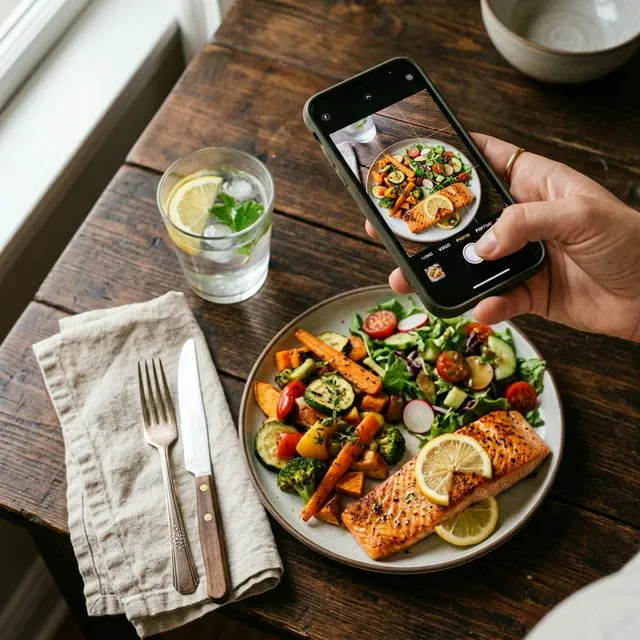
You can track calories without counting by using photo-based AI tools, the hand-portion method, or the plate method — all of which give you meaningful calorie awareness without weighing food or logging every ingredient. The goal isn’t perfect accuracy. It’s building awareness that lasts.
Traditional calorie counting works in theory but fails in practice for most people. A 2022 study in Obesity Reviews found that fewer than 20% of people who start manual calorie tracking maintain it beyond 3 months. The process is tedious — searching databases, estimating portions, entering data for every meal. The friction kills the habit before it produces results.
This guide covers six practical methods to track your food intake without the burnout of counting every calorie. Some are tech-based, some are old-school, and the best approach often combines two or three.
Method 1: AI Photo Tracking
The fastest way to track calories without manually counting is to let AI do it. Modern AI calorie counters can analyze a meal photo and estimate calories and macros in under 3 seconds — no barcode scanning, no database searching, no weighing.
How it works: you take a photo of your plate, send it to an AI tool (like Nouri), and get back an estimate of calories, protein, carbs, and fat. The AI recognizes foods, estimates portion sizes from visual cues, and calculates nutrition instantly.
The accuracy of photo-based tracking has improved dramatically since 2023. Research published in the Journal of the Academy of Nutrition and Dietetics found that AI-assisted dietary assessment achieved within 10-15% accuracy of manual weighed records — close enough for practical use. The trade-off of slightly lower precision is massively higher consistency, because people actually use it day after day.
Best for: people who want data-driven insights but hate manual logging. If you’ve tried MyFitnessPal and quit, this approach eliminates the step that made you quit.
Method 2: The Hand-Portion Method
If you want zero technology involved, the hand-portion method is the simplest calorie-tracking system that actually works. Developed by Precision Nutrition, it uses your own hand as a measurement tool:
- Palm = 1 serving of protein (~20-30g protein, ~150-200 cal)
- Fist = 1 serving of vegetables (~25-50 cal)
- Cupped hand = 1 serving of carbs (~20-30g carbs, ~100-150 cal)
- Thumb = 1 serving of fat (~7-12g fat, ~70-100 cal)
A typical meal for a moderately active person might be: 1-2 palms of protein + 1-2 fists of vegetables + 1-2 cupped hands of carbs + 1-2 thumbs of fat. No phone needed, no app required, works anywhere in the world.
The limitation: it’s less precise than AI tracking, and it doesn’t give you cumulative daily data. But for people who are overwhelmed by numbers, it provides a structure that’s almost impossible to forget once learned.
Method 3: The Plate Method
Used by the American Diabetes Association and recommended by multiple health organizations, the plate method divides your plate visually:
- ½ plate = non-starchy vegetables (leafy greens, broccoli, peppers)
- ¼ plate = lean protein (chicken, fish, tofu, eggs)
- ¼ plate = complex carbs (rice, pasta, sweet potato, bread)
This method naturally limits calorie-dense foods while maximizing volume from low-calorie vegetables. A portion-controlled plate using this method typically contains 400-600 calories — without counting a single one.
The plate method is particularly effective for weight loss because the high vegetable proportion increases satiety through fiber and volume. Research from Harvard’s T.H. Chan School of Public Health has consistently shown that plate composition matters more than strict calorie targets for sustainable weight management.
Method 4: Food Quality Focus
This approach flips the framework entirely: instead of tracking how much you eat, you focus on what you eat. The principle is simple — if you eat mostly whole, minimally processed foods, your body’s natural satiety signals will regulate intake more effectively than any tracking app.
The evidence is strong. A 2019 NIH study by Kevin Hall et al. compared ultra-processed vs. unprocessed diets and found that participants eating ultra-processed food consumed an average of 508 more calories per day — without intending to. The processed food disrupted natural hunger signals.
Practical rules for the food-quality approach:
- Shop the perimeter of the grocery store (produce, meat, dairy → fewer processed items)
- If the ingredient list has more than 5 items, think twice
- Prioritize foods you could theoretically make at home, even if you don’t
- Minimize liquid calories (sodas, juices, sugary coffee drinks)
This method works well as a foundation alongside any of the other methods listed here. Calculate your baseline needs with our TDEE calculator, then focus on food quality rather than hitting exact calorie numbers.
Method 5: Meal Templates
Here’s a strategy most fitness coaches use but rarely talk about: build a library of 10-15 meals you enjoy, pre-calculate them once, and rotate through them. This gives you calorie awareness without daily tracking effort.
For example, if you know your regular breakfast (Greek yogurt + berries + granola) is ~400 cal, your typical lunch (chicken salad wrap) is ~550 cal, and your go-to dinner (salmon + rice + vegetables) is ~650 cal — that’s 1,600 cal without counting anything on those days.
The key insight: most people eat 80% of their calories from the same 15-20 meals. Calculate those meals once using a macro tracker or nutritional database, then you never need to count again for those meals. Only track when you eat something new or unusual.
Method 6: Mindful Eating
Mindful eating focuses on the experience of eating rather than the numbers. The core practices are:
- Eat slowly — put your fork down between bites
- Eat without screens (no phone, TV, or laptop)
- Stop at 80% full (the Japanese principle of Hara Hachi Bu)
- Notice texture, flavor, and satisfaction as you eat
A systematic review in the American Journal of Clinical Nutrition found that mindful eating interventions reduced binge eating episodes by 68% and contributed to modest but sustained weight loss. It’s not about counting — it’s about paying attention.
Mindful eating works best when combined with another method. For instance, use photo tracking to build awareness of what you eat, then apply mindful eating principles to change how you eat.
Which Method Should You Choose?
| Method | Effort | Accuracy | Best for |
|---|---|---|---|
| AI Photo Tracking | Very low | High (±15%) | Data-driven people who hate manual logging |
| Hand Portions | Low | Moderate (±25%) | People who prefer zero technology |
| Plate Method | Low | Moderate | Weight loss, diabetes management |
| Food Quality Focus | Medium | Low-Moderate | General health, anti-processed diet |
| Meal Templates | Front-loaded | High | Routine eaters, meal preppers |
| Mindful Eating | Medium | N/A (behavioral) | Emotional eaters, binge eating |
Most people do best combining AI photo tracking for awareness with one structural method (hand portions or plate method) for habit building. This gives you data when you want it and a simple framework when you don’t have your phone handy.
Why Traditional Calorie Counting Fails
Before committing to an alternative method, it’s worth understanding exactly why standard counting fails. The problem isn’t the science — energy balance is real. The problem is the implementation. Here’s what the research and our experience building calorie tracking tools has taught us:
- Database fatigue: Manually searching for “homemade chicken stir-fry” among 50 similar entries takes longer than eating the food
- Estimation errors: People systematically underestimate calories by 30-50%, even with training (per a 2013 BMJ study)
- Obsessive behavior: For some people, numerical tracking triggers anxiety and disordered eating patterns
- Social friction: Logging every ingredient at a restaurant or dinner party creates awkwardness that most people avoid
This is why we’ve seen the biggest results with tools that keep the awareness of tracking while removing the friction — exactly what people who quit calorie tracking apps were missing.
The Bottom Line
You don’t need to count every calorie to manage your weight or improve your nutrition. The best tracking method is the one you’ll actually stick with. For most people, that means something with very low daily effort and enough feedback to build awareness.
AI photo tracking offers the best ratio of insight-to-effort in 2026. If you want guidance on top of tracking — someone to nudge you when you’re behind on protein, or flag a sodium spike before the weekly report — AI nutrition coaching layers on top of the photo workflow. For grocery decisions, an AI food label scanner handles packaged products.
But whether you prefer hand portions, the plate method, or mindful eating — any of these approaches will keep you more informed than doing nothing. Start with one method, give it two weeks, and adjust from there.
Track calories without counting
Send a meal photo → get calories and macros in 3 seconds. No database searching, no barcode scanning.
Try Nouri Free
Sources
- Hall KD, et al. — “Ultra-processed diets cause excess calorie intake and weight gain: An inpatient randomized controlled trial.” Cell Metabolism, 2019.
- Painter SL, et al. — “What matters in weight loss? An in-depth analysis of self-monitoring.” Journal of Medical Internet Research, 2017.
- Harvard T.H. Chan School of Public Health — Healthy Eating Plate
- BMJ — Accuracy of calorie estimation in large food portions (2013)
- American Diabetes Association — Plate Method for Meal Planning

This article is for informational purposes only and does not constitute medical or dietary advice. Consult a qualified healthcare professional before making changes to your diet.