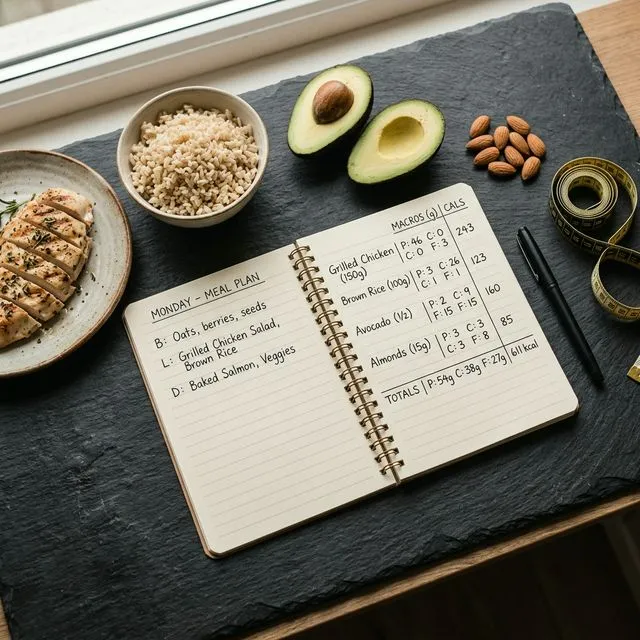
Macros — short for macronutrients — are the three types of nutrients your body needs in large amounts: protein, carbohydrates, and fat. While total calories determine whether you gain or lose weight, your macro ratio determines what kind of weight changes — muscle vs. fat. This guide explains how to calculate your personal macro targets, choose the right split for your goals, and actually stick with it.
If you just want the numbers, use our free macro calculator — it takes 30 seconds. Read on if you want to understand why those numbers matter.
What Are Macronutrients?
Every food you eat contains some combination of three macronutrients. Each one serves a different purpose and provides a different amount of energy:
- Protein — 4 calories per gram. Builds and repairs muscle tissue, supports immune function, and keeps you feeling full longer. Found in meat, fish, eggs, dairy, legumes, and tofu.
- Carbohydrates — 4 calories per gram. Your body’s primary fuel source, especially during exercise. Found in grains, fruits, vegetables, bread, pasta, and sugar.
- Fat — 9 calories per gram. Essential for hormone production, brain function, and absorbing fat-soluble vitamins (A, D, E, K). Found in oils, nuts, avocado, butter, and fatty fish.
Alcohol provides 7 calories per gram but isn’t classified as a macronutrient because it has no nutritional function. Fiber is technically a carbohydrate, but your body can’t fully digest it — which is why high-fiber foods tend to be lower in “usable” calories.
Why Macros Matter More Than Just Calories
Two people can eat 2,000 calories a day and get completely different results. Person A eats mostly protein and whole foods — they maintain muscle, lose fat, and feel energized. Person B eats mostly processed carbs and little protein — they lose muscle along with fat and feel tired.
A 2018 systematic review in the British Journal of Sports Medicine found that higher protein intake (1.6–2.2 g/kg body weight) significantly increased muscle mass during resistance training compared to lower intakes. The researchers concluded that protein distribution matters as much as total intake for body composition outcomes.
This is why knowing your TDEE (total daily energy expenditure) is just the starting point. Splitting those calories into the right macro ratio is what determines whether you’re building muscle, maintaining it, or losing it.
How to Calculate Your Macros: Step by Step
Step 1: Find Your Daily Calorie Target
Before you can split calories into macros, you need to know how many calories you need per day. This starts with calculating your Basal Metabolic Rate (BMR) — the calories your body burns at rest — and then multiplying by an activity factor to get your TDEE.
The Mifflin-St Jeor equation, recommended by the American Dietetic Association, is the most accurate general formula:
- Men: BMR = 10 × weight(kg) + 6.25 × height(cm) − 5 × age − 5
- Women: BMR = 10 × weight(kg) + 6.25 × height(cm) − 5 × age − 161
Then multiply your BMR by your activity level (1.2 for sedentary, 1.55 for moderate, 1.725 for very active) to get your TDEE. Or skip the math entirely with our TDEE calculator.
Step 2: Adjust for Your Goal
Once you have your TDEE, adjust it based on what you’re trying to achieve:
- Fat loss: Subtract 300–500 calories from TDEE. A larger deficit leads to faster weight loss but increases muscle loss risk.
- Maintenance: Eat at your TDEE. Good for body recomposition when combined with resistance training.
- Muscle gain: Add 200–400 calories above TDEE. A moderate surplus minimizes fat gain while supporting growth.
Step 3: Choose Your Macro Split
Now divide your calorie target into protein, carbs, and fat. There’s no single “best” ratio — it depends on your goal, activity type, and preference. Here are the most evidence-based splits:
| Split | Protein | Carbs | Fat | Best for |
|---|---|---|---|---|
| Balanced | 30% | 40% | 30% | General fitness & health |
| High Protein | 40% | 30% | 30% | Muscle gain & fat loss |
| Low Carb | 35% | 25% | 40% | Blood sugar control |
| Keto | 25% | 5% | 70% | Ketogenic diet |
Step 4: Convert Percentages to Grams
Once you’ve chosen your split, convert calories to grams for each macro. Here’s the math for a 2,200-calorie diet with a High Protein split (40/30/30):
- Protein (40%): 2,200 × 0.40 = 880 cal ÷ 4 = 220g protein
- Carbs (30%): 2,200 × 0.30 = 660 cal ÷ 4 = 165g carbs
- Fat (30%): 2,200 × 0.30 = 660 cal ÷ 9 = 73g fat
Or skip the math — our macro calculator does all of this in one step.
How Much Protein Do You Actually Need?
Protein is the most debated macro. The RDA minimum is 0.8 g/kg of body weight — but this is the amount to avoid deficiency, not the amount for optimal body composition.
Research paints a clearer picture:
- Sedentary adults: 0.8–1.0 g/kg is sufficient for basic health.
- Recreational exercisers: 1.2–1.6 g/kg supports recovery and gradual muscle gain.
- Athletes and active lifters: 1.6–2.2 g/kg is optimal for muscle protein synthesis, according to a meta-analysis by Morton et al. in the British Journal of Sports Medicine (2018).
- During a calorie deficit: Increase to 1.8–2.4 g/kg to minimize muscle loss. A study in the American Journal of Clinical Nutrition (2016) found that higher protein during a deficit preserved lean mass even with aggressive calorie restriction.
For most people trying to stay fit and lose some fat, 1.6–2.0 g/kg is a practical target. That’s roughly 120–160g per day for a 80kg person.
Common Mistakes When Tracking Macros
1. Obsessing Over Exact Numbers
Macro targets are estimates, not commands. Hitting within ±10% of each target is more than good enough. A study in the Journal of the Academy of Nutrition and Dietetics found that perfectionism is one of the top reasons people quit tracking. Aim for “close enough” consistently rather than “perfect” sporadically.
2. Ignoring Fiber and Micronutrients
Hitting your macro targets with only protein shakes, white rice, and oil is technically possible — but not healthy. Fiber (25–30g/day), vitamins, and minerals matter too. Fill your carb macro with whole grains, vegetables, and fruit whenever possible.
3. Not Adjusting Over Time
Your macros aren’t set-and-forget. As your weight changes, your calorie needs change too. Recalculate every 4–6 weeks during active dieting, or whenever your weight shifts by more than 2–3 kg.
4. Fighting Your Preferences
If you hate eating rice, don’t force a high-carb split. If you love avocados and nuts, a higher-fat split might be more sustainable. The best macro ratio is the one you can actually maintain long-term.
How to Track Macros Without Burnout
Traditional macro tracking — weighing food, searching databases, logging every ingredient — works but requires significant daily effort. Research consistently shows that reducing friction in food logging is the single biggest factor in long-term tracking adherence.
A few strategies that help:
- Prepare repetitive meals. If breakfast and lunch are roughly the same each day, you only need to track dinner. This alone cuts tracking effort by 60%.
- Use photo-based tracking. Instead of searching food databases manually, take a photo and let AI estimate macros for you. Our macro tracker from photo does exactly this — no searching, no weighing.
- Track protein, relax on the rest. If tracking three macros feels overwhelming, prioritize protein. Hit your protein target and let carbs and fat fill in naturally around it.
- Don’t track forever. Most people develop a solid intuition for portion sizes after 3–6 months of consistent tracking. The goal is to learn what a balanced plate looks like, not to track food for the rest of your life.
Skip the manual logging
Nouri tracks your macros from a photo. Just snap a picture of your meal — AI estimates protein, carbs, fat, and compares it against your daily targets.
Try Nouri Free
Macro Calculator vs. Calorie Counter: What’s the Difference?
A calorie counter tells you how much you’re eating. A macro calculator tells you what you should be eating. In practice:
- Calorie counting is simpler — one number to hit. Good for straightforward weight loss where you don’t care about body composition.
- Macro tracking gives more control — three numbers to balance. Better for building muscle, preserving lean mass during a cut, or optimizing athletic performance.
In our experience building Nouri, we’ve found that users who track macros — even roughly — are significantly more likely to report feeling satisfied with their results compared to those who track only total calories.
If you’re unsure where to start, begin with a simple AI calorie counter and graduate to macro tracking once you have a consistent tracking habit.
The Bottom Line
Understanding macros gives you a level of control over your body composition that calorie counting alone can’t match. The math is straightforward: find your TDEE, pick a split that fits your goal, convert to grams, and track consistently — even imperfectly.
The hardest part isn’t calculating macros. It’s tracking them day after day without burning out. That’s exactly the problem AI-powered tools are solving — by reducing minutes of manual logging to seconds of photo capture.
Sources
- Morton RW, et al. — “A systematic review, meta-analysis and meta-regression of the effect of protein supplementation on resistance training-induced gains in muscle mass and strength in healthy adults.” British Journal of Sports Medicine, 2018.
- Mifflin MD, St Jeor ST, et al. — “A new predictive equation for resting energy expenditure in healthy individuals.” American Journal of Clinical Nutrition, 1990.
- Longland TM, et al. — “Higher compared with lower dietary protein during an energy deficit combined with intense exercise promotes greater lean mass gain and fat mass loss.” American Journal of Clinical Nutrition, 2016.
- American Heart Association — Protein and Heart Health
- Mayo Clinic — Carbohydrates: How carbs fit into a healthy diet

This article is for informational purposes only and does not constitute medical or dietary advice. Consult a qualified healthcare professional before making changes to your diet.